
About Family Mediator
About Our Family Mediation Service: Impartial Support for Families Facing Change
An impartial, practical approach to family decisions, built around safety, plain language and the people who will live with the outcome.
We do not take a side, and we do not decide who is right.
You choose to start, and you can stop or pause at any point.
We explain things in ordinary words and check they make sense.
Any arrangement is agreed by the people who will live with it.
Our work
What we do, in plain terms

We sit with two or more people who need to make decisions about their family and cannot easily make them alone. Our job is to keep those conversations orderly, fair and focused on the choices in front of you, so that you leave with something more useful than another argument.
Most of the people who call us are separating or have already separated. Some are parents trying to work out a weekly pattern for the children. Others are sorting out the home, the savings, the car, or who pays which bill while the bigger questions are settled. A smaller number are grandparents, adult siblings or step-parents who want to talk through contact, care for an older relative, or a family business that has become a source of strain.
In practice, a session looks less dramatic than people expect. There is a table, or a video call, and a short list of topics that everyone has agreed to cover. One person speaks while the other listens, then the roles swap. We summarise what we have heard, check we have it right, and ask questions that move things along: "What would Tuesday look like under that plan?" or "If the car stays with one of you, what happens about the school run on wet days?"
We do not hand down answers. We help you find out which answers you can both accept, and we write those down clearly so nobody has to rely on memory later. Where a conversation needs information that neither of you has, such as a valuation, a pension figure or legal advice, we say so and suggest you get it before going further.
Take a typical example. Two parents have separated over the summer. One has moved into a flat ten minutes away, the children are still at the family home, and every evening ends in a tense exchange of messages about who is collecting whom. Neither wants a battle. Both want the children settled before the autumn term. In a first joint session, we might agree to focus on just three things: the weekly pattern, how handovers will work, and how the parents will message each other in the meantime. The house and the finances can wait for a later session, once the day-to-day pressure has eased.
That kind of narrowing is a large part of what we offer. When everything feels urgent, it is hard to make progress on anything. Choosing one or two decisions to tackle first, and leaving the rest on a list for later, often brings the temperature down enough for people to think clearly again.
Every enquiry begins with a telephone call. You can ring, describe your situation in your own words and ask whatever you need to ask before deciding anything. Questions about charges, formats or timing are best raised on that call, because the answers depend on your circumstances.
Context
Where mediation sits among your options

Mediation is one route among several. It helps to see it alongside the others, because each has a place and none is right for every family. The comparison below is general. It is not legal advice, and a solicitor can tell you how these routes apply to your own situation.
- Talking it through alone
- Two people sit down, perhaps at the kitchen table, and work things out between themselves. It costs nothing and keeps everything private. It works well when communication is reasonably calm and both people feel able to say what they think. It tends to struggle when one person feels talked over, when the same disagreement keeps returning, or when nobody writes down what was agreed.
- Mediation
- The same people make the decisions, but an impartial third person runs the conversation. The mediator sets an agenda, keeps the pace manageable and makes sure both voices are heard. Proposals come from the participants. Any outcome is written down as a summary of what was discussed and agreed, and either person can take it to an adviser before relying on it.
- Negotiation through solicitors
- Each person instructs their own solicitor, who puts forward proposals and responds on their behalf. You gain someone whose job is to advise and protect your position. The trade-off is often less direct control over tone and timing, and exchanges that can take longer because they pass through more hands.
- A court application
- A judge or magistrate makes a decision when the people involved cannot. This can be necessary, particularly where there are safety concerns or one person will not engage at all. It also means a stranger decides matters about your family, on a timetable you do not control.
These routes are not sealed off from one another. Plenty of people take legal advice alongside mediation. Some settle most issues in mediation and leave one point for their solicitors. Others try mediation, find it is not working, and move to a different route without losing anything they learned along the way.
If you are unsure which route fits, that uncertainty is a perfectly good reason to call. We can describe how mediation works, and you can weigh it against what a solicitor tells you. Nobody expects you to know the answer before you pick up the phone, and asking a question does not commit you to anything.
How we work
The principles we work to

Five working principles shape how we run every conversation. They are not slogans. Each one changes what we actually do in the room.
Impartial
We have no stake in the outcome. If we notice that one of you is getting more airtime, or that a question has been aimed at one person more than the other, we correct it. We will not tell either of you that you are being unreasonable.
Voluntary
Nobody is made to stay. You can ask for a break, end a session early or decide not to continue. Pausing is not failure, and it does not stop you using another route later.
Confidential within limits
What is said in mediation is normally kept private. There are limits, and we explain them before anything starts. The most important is that if we learn of a risk of serious harm to a child or an adult, we may need to act on it.
Informed
Decisions are only as good as the information behind them. We encourage both of you to share relevant facts openly and to take independent advice where it would help, before anything is settled.
Child-aware
Children are rarely in the room, but their lives are on the table. We keep asking how a proposal would feel from their side, not just whether it is fair between the adults.
Being honest about confidentiality
People often assume that anything said in mediation can never be repeated anywhere. The reality is more nuanced, and we would rather you heard it from us at the start. Confidentiality protects the space for honest discussion, but it cannot protect someone who is at risk. If something said suggests that a child or an adult may be harmed, we may have to stop the session and take appropriate steps. Factual information, such as financial figures disclosed so that you can make decisions, may also be treated differently from the general discussion. We explain how this works in practice before your first joint session, and you are welcome to ask questions about it on the initial call.
Responsibilities
Who holds which part of the process

Confusion about roles causes a surprising amount of frustration. One person expects the mediator to tell the other that a proposal is unfair. Another expects a legal view on what a court would do. Being clear about who holds what keeps the process honest and stops anyone feeling let down.
Roughly speaking, we hold the structure, the pace and the balance of the conversation. You hold your priorities, your proposals and your decisions. Independent advisers, such as solicitors or financial specialists, hold the legal and financial advice that neither of us can give you.
What the mediator does
- Agrees an agenda with you so the most pressing topics come first.
- Keeps turns fair, and slows things down when tempers rise.
- Asks practical questions that test whether an idea would work day to day.
- Notices when information is missing and says so plainly.
- Explains general options and where independent advice might help.
- Writes a clear summary of what was discussed and any proposals reached.
- Checks, throughout, that mediation remains safe and suitable.
What the mediator does not do
- Take sides, or tell either person what they ought to accept.
- Give legal advice or predict what a court might decide.
- Give financial advice about pensions, tax or mortgages.
- Act as a counsellor or therapist, though we recognise emotions matter.
- Pressure anyone to agree, or to keep going when they want to stop.
- Promise a particular outcome, timescale or result.
- Make decisions on your behalf.
You may notice that the second list matters as much as the first. People sometimes find it reassuring to hear that nobody will be pushed into an agreement. Others are disappointed at first that we will not simply tell the other person they are wrong. In our experience, the arrangements that last are the ones both people built and both people can explain.
Children
Keeping children's everyday lives in view

When adults disagree, the conversation can drift towards principles: fairness, equal time, who did more. Those things matter, but a child experiences an arrangement as a series of ordinary days. We bring the discussion back to those days, one at a time, and ask how each proposal would actually feel to live through.
The practical questions that shape a week
A plan that looks balanced on paper can fall apart on a Wednesday morning. So we ask detailed questions. Who does the school run on the days when one parent starts work at seven? Where does the PE kit live, and who remembers to wash it? If handover happens at a parent's home, is that a calm moment for the children or a tense one on the doorstep? Would handing over at the school gate, or at a grandparent's house, take some of the heat out of it?
Birthdays and festivals often need a conversation of their own. Some families alternate years. Others split the day, or keep a birthday with the parent the child is staying with and arrange a second celebration at the other home. Holiday weeks, half-terms and travel abroad raise their own practical points, such as passports, notice periods and how the children stay in touch with the parent they are not with.
Different ages, different needs
Younger children usually rely on predictable routines. A toddler's nap, a regular bedtime and a familiar comfort toy that travels between homes can matter more than the exact number of nights in each house. Short, frequent time with each parent often suits very young children better than long gaps, though every family is different.
Teenagers are a different matter. A fifteen-year-old with a Saturday job, weekend football and exams may want a say in where they spend their time, and may resent a rigid timetable designed without them. We talk with parents about how a teenager's view can be heard in a way that does not place the young person in the middle or make them choose between parents. Sometimes that means parents agreeing to have a calm conversation with their teenager together. In some situations, and only where it is suitable and everyone agrees, a young person's views can be heard more directly. We can explain on the call what that might involve.
Keeping children out of the adult argument
Children pick up more than adults realise. Messages passed through them, questions about what the other parent said, or arguments overheard at handovers can weigh heavily. Part of our work is helping parents agree how they will communicate with each other, whether that is a shared calendar, a weekly message or a short notebook that travels with the children, so that the children do not have to carry it.
Suitability
When mediation is not the right step
Mediation works best when both people can speak freely and safely. That is not always the case, and pretending otherwise would do real harm. Before any joint conversation, we ask questions about safety and suitability, and we keep checking as things go on.
If you or anyone else is in immediate danger, call 999. Mediation is not an emergency service, and we cannot respond to urgent safety concerns. If you are worried about your safety but not in immediate danger, tell us on the call so we can talk about whether mediation is appropriate and what else might help.
There are situations where mediation may be unsuitable, or may need to be adapted. These include a history of domestic abuse or coercive control, fears about a child's safety, one person feeling too intimidated to disagree, or serious difficulties caused by addiction or mental health that make a fair conversation hard. We look at each situation on its own terms rather than applying a fixed checklist, and we will be honest if we think another route would serve you better.
Three possible outcomes of a suitability check
The first is that mediation goes ahead in the usual way. The second is that it goes ahead in an adapted form. That might mean the two of you sit in separate rooms while we move between you, sessions held online from different locations, staggered arrival and departure times, shorter sessions with more breaks, or a supporter or interpreter being involved where appropriate. The third is that we pause, or recommend not starting at all, and talk with you about other routes such as taking legal advice, seeking specialist support or, where needed, a court application.
Pausing can feel like a setback. Often it is the most sensible decision available. A break of a few weeks while someone gets advice, or while the dust settles after a house move, can make later conversations far more productive. And deciding mediation is not for you does not close any other door.
Over time
How progress usually builds
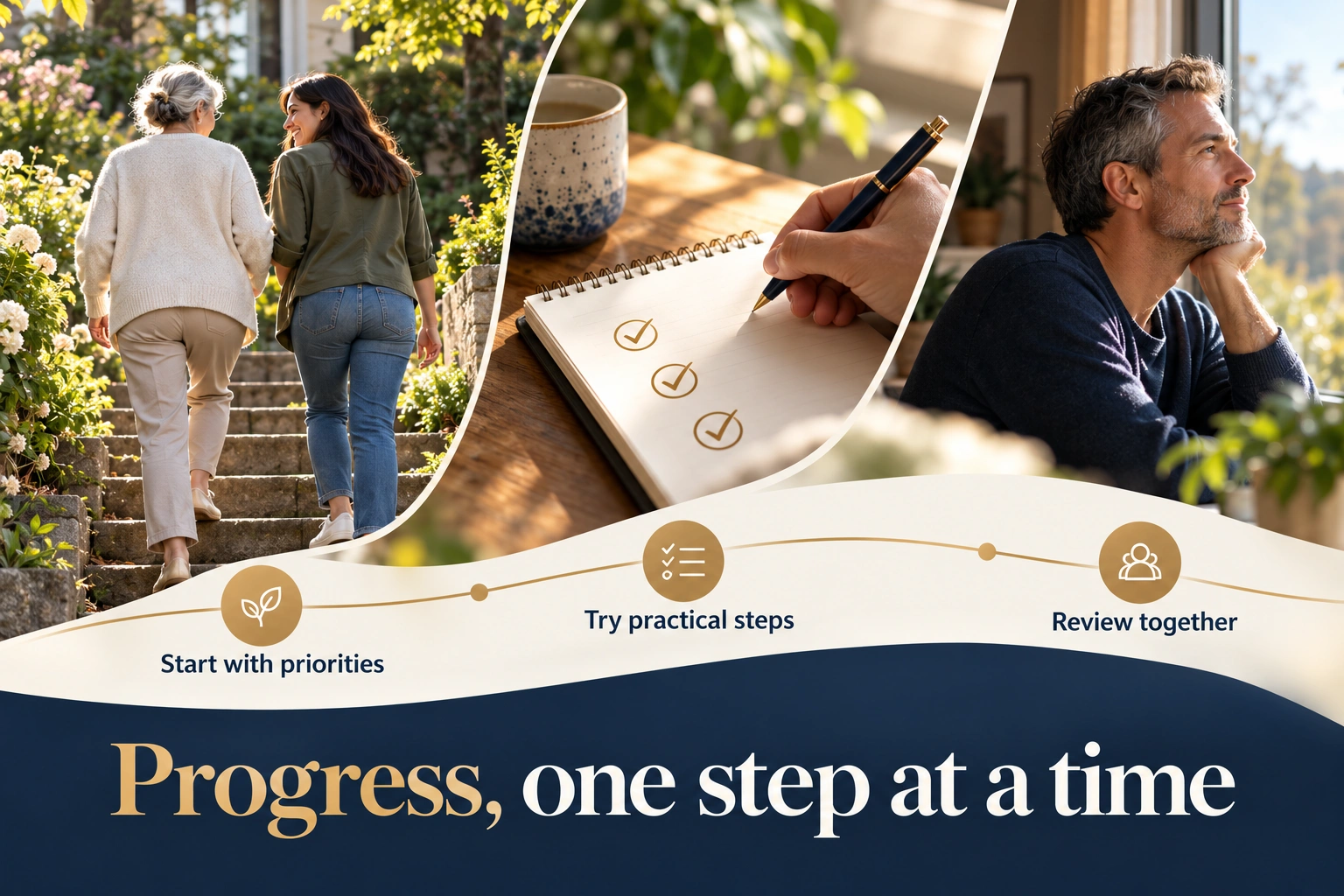
Few families resolve everything in one conversation. Progress tends to come in stages, each one making the next a little easier. The pattern below is typical rather than fixed. Some families move through it quickly, others return to an earlier stage when circumstances change, and that is entirely normal.
Understand
We start by finding out what each person needs to decide, what worries them most and what information is available. For one couple, the urgent question is which parent has the children over the coming fortnight. For another, it is whether the family home can be kept.
Explore
Next comes a wider look at possibilities. We encourage ideas without anyone having to commit to them yet. Could the children stay in the house while the parents rotate? Could the car be sold and the money split, or kept by whoever does more driving? Listing options often shows there are more than two.
Test
Promising ideas are then tested against real life. What happens when someone is ill, works late or moves job? Some families try an arrangement for a few weeks before agreeing it, then come back to adjust what did not work.
Record
Finally, the proposals you have reached are written down in clear language. You can each take that summary to an independent adviser before relying on it, and you can return to mediation later if circumstances change.
Sometimes the most useful outcome is partial. You might agree the weekly pattern for the children but still need help with the finances. Narrowing the gap, even without closing it, can save time, stress and expense later, whatever route you take next.
Communication
How we speak and write
Family decisions are hard enough without jargon on top. We use ordinary words, short sentences and examples drawn from your own situation. If a term is unavoidable, we explain it the first time it comes up. If something we said was unclear, we would much rather you stopped us and asked than nodded along.
If you cannot explain an agreement to a friend over a cup of tea, it has not been written clearly enough. That is the standard we hold our summaries to.
The same applies to anything written down. A summary should tell you who agreed what, from when, and what happens if plans change. It should not leave you guessing about what "reasonable contact" or "flexible arrangements" means on an actual Friday. Where you would find a different format easier, such as larger print, a simpler layout or extra time to read before a session, please mention it on the call. Language support can also be discussed where it would help you take part fully.
Questions
Questions people ask about us
Do you work for one person or both?
Neither person is our client in the sense of being represented. We work for the process, which means keeping it fair to everyone taking part. That is why we will not advise one person privately on how to get a better result.
Will you tell us what a fair outcome looks like?
No. We can explain the kinds of things families generally consider and point out where independent legal or financial advice would help, but deciding what is fair for your family is up to you. A solicitor can give you a view on your legal position.
What if the other person does not want to take part?
Mediation is voluntary, so nobody can be made to attend. If you call first, we can talk about what usually happens next and the options available to you. Sometimes a person who is hesitant becomes more willing once they understand what mediation involves.
Do we have to be in the same room?
Not necessarily. Separate rooms, online sessions from different locations and other adjustments can be discussed. The right format depends on your situation and on what the suitability check shows.
Is everything I say kept private?
Generally yes, but with limits. If something suggests a risk of serious harm to a child or an adult, we may need to act on it. Financial information shared to support decisions may also be handled differently. We explain these limits clearly before anything begins.
Will an agreement made in mediation be legally binding?
A mediation summary records what you have discussed and proposed. It is not in itself a court order. If you want an arrangement to have legal effect, you should take independent legal advice about what would be needed.
How much does it cost and how long does it take?
That depends on your circumstances, the issues involved and the number of sessions you need. Please ask on the call, where we can talk through what applies to you before you commit to anything.
Can we come back if things change later?
Yes. Children grow, jobs change and people move. Many families find that an arrangement which worked for a primary-school child needs revisiting when that child starts secondary school. Returning to mediation to update a plan is common and sensible.
Ready to talk about your next step?
Call us, explain what is happening in your own words, and take your time deciding what comes next.